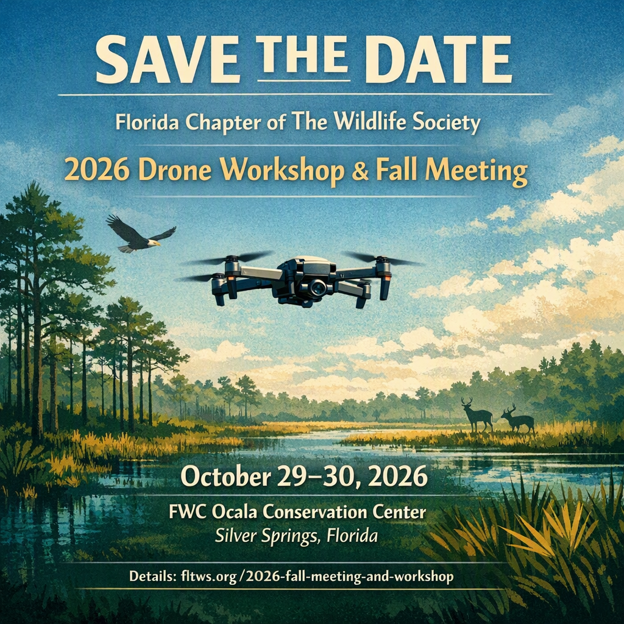
Join the Florida Chapter of The Wildlife Society for the 2026 Drone Workshop & Fall Meeting, October 29–30 at the FWC Ocala Conservation Center in Silver Springs, Florida. Explore practical drone applications in wildlife conservation through presentations, outdoor demonstrations, and networking with professionals and partners.
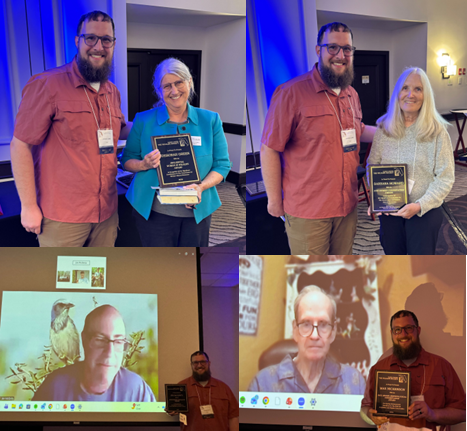
The Florida Chapter of The Wildlife Society is pleased to announce the winners of our 2026 Awards of Excellence!
Dive into the wild, real-life adventures of FLTWS wildlife professionals with our brand new book “Running With The Dogs: True Adventure Stories by Wildlife Biologists”. Click here to find out how to get your copy!
The Florida Chapter of The Wildlife Society is pleased to announce that Meghan White of Florida Atlantic University is the 2026 recipient of the Courtney A. Tye Memorial Graduate Student Scholarship, and Kiara Viale of the University of Florida is the recipient of the 8th annual Undergraduate Diversity Student Scholarship.
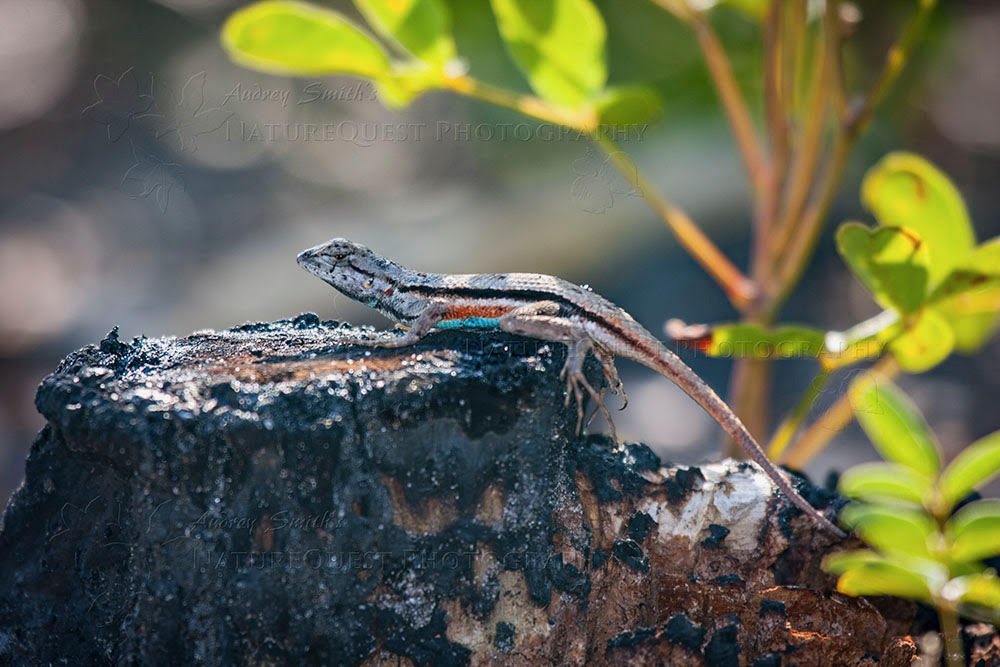
Learn about an important species: The Florida Scrub Lizard. Learn how it is identified, habitat range and why it is so important for Florida wildlife.
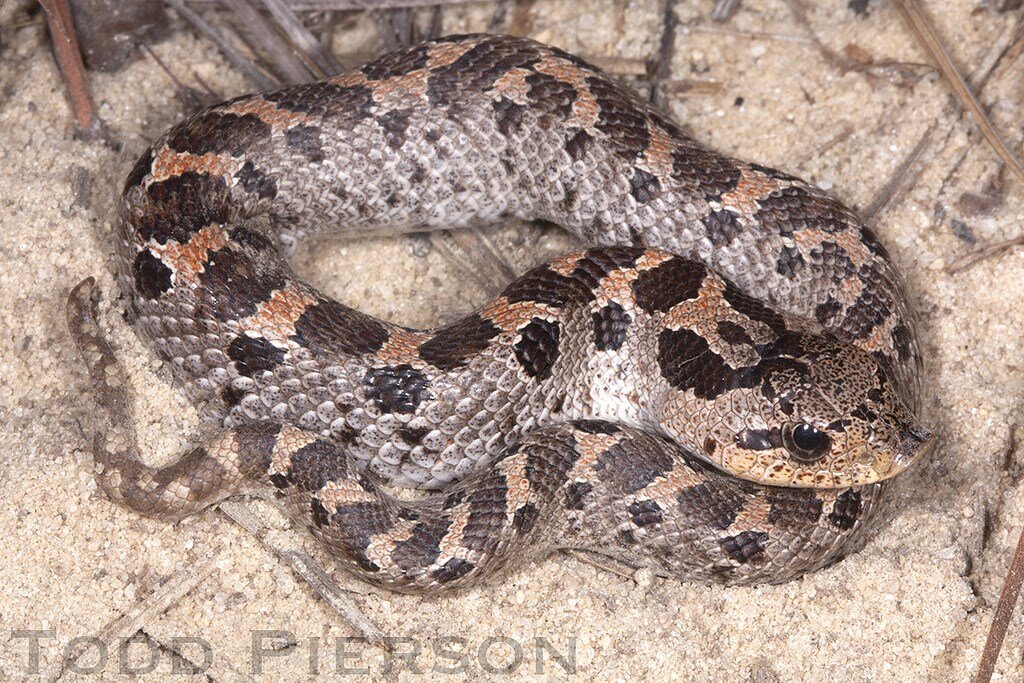
The Southern Hognose snake is an extremely shy and allusive non-venomous reptile (The Eastern Hognose does produce a mild venom). Though rarely seen, they can be identified by their distinct pointed, and upturned snouts. They average around 35.6 cm in length and have been recorded as long as 61cm. The females are generally larger than the males of this species. Both males and females are generally gray, with black blotches on their backs and sides, however they can have tan or auburn tints as well. The Southern Hognose is often misidentified as its cousin, the Eastern Hognose snake. When threatened, the Southern Hognose can spread their necks out, similar to a cobra, and hiss loudly. They rarely strike or bite in self-defense, but they have been documented rolling over onto their backs and “playing dead”. Their diet consists of lizards, rodents, and other small vertebrates, but they primarily feed on frogs and toads, using their posterior fangs to capture prey, and to deflate any toad or frog.
The Panama City crayfish (Procambarus econfinae) (PCC) is a small freshwater crustacean growing to about two inches in length (body length minus claws). The dorsal side of this crayfish consist of a dark brown background color with a lighter brown dorsal stripe running the entire length of the animal. The sides of the crayfish are a light brown with dark brown spots. The size, claw shape, and leg arrangement identify the Panama City Crayfish from other crayfish sharing the same geographic range.
The American mink (Neovison vison) is a semi-aquatic, carnivorous predator of the weasel family. They have long streamline bodies, small heads, and rounded ears with chocolate colored fur. Often, white markings occur on the chin or belly or both. Mink exhibit sexual dimorphism with the males being longer and heavier than females. Males vary in total length from 19-28 inches and weight from 1-3 pounds, while females measure 18-23 inches and weigh 1-2 pounds. Mink are frequently mistaken for river otters (Lontra canadensis), but they can be differentiated by their smaller size and pointed muzzle. River otter are twice as long and more than four times as heavy.
The FWC asks you to report sightings of the rare Rainbow Snake https://content.govdelivery.com/accounts/FLFFWCC/bulletins/3ee59e7
Click this story to read more.
402 properties are currently being reviewed and ranked in the 2025 Project Cycle of the Rural and Family Lands Protection Program. Click here to learn more.
The Wildlife Society’s Joshua Rapp reports on a recently published study where researchers “tracked the survival rates of gopher tortoises translocated to Nokuse, a 55,000-acre property on the Florida Panhandle near Panama City that hosts reintroduced gopher tortoises moved as mitigation measures and conducts longleaf pine restoration and other conservation work”. Click HERE to read the story.
Sponsors
Your logo could go here.
Scroll to the bottom of our webpage for details.
JOBS
(click heading for full list)
BECOME OUR SPONSOR
If you have any questions about FLTWS sponsorship, please reach out to our Fundraising Committee members
Larry Perrin and Mark Ausley at fundraising@fltws.org

Catch up on what the FLTWS Chapter has been up to! This newsletter discusses the 2026 Spring Conference as well as upcoming workshops.