
Sceloporus woodi
Identification
The Florida scrub lizard is a small, gray or reddish-brown lizard. Adults are only about 5 inches long in total. They have thick brown stripes down each side of the body. There is sexual dimorphism (some physical difference) between the males and females; adult males have bright turquoise patches on their sides and a black throat with small turquoise patches there as well. Females sometimes have faded patches on their undersides. Adult males usually do not bear markings on their back, while females will typically have anywhere from 7-10 squiggly brown lines. Juveniles of this species most closely resemble the females.
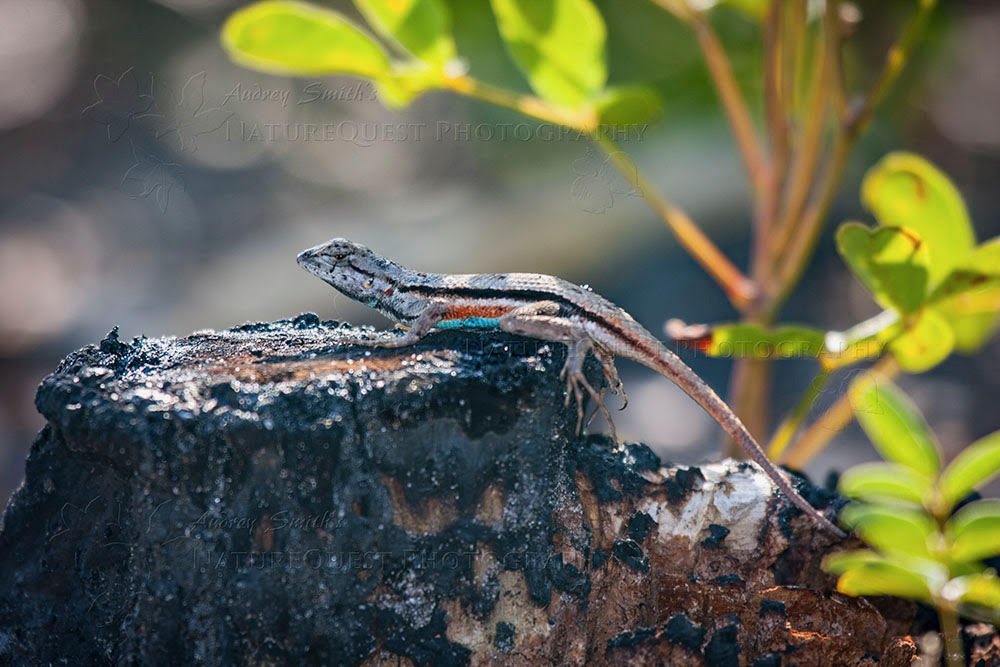
Image courtesy of Audrey Smith
Range
These lizards are endemic to Florida. There are currently fragmented populations within Central Florida and along Florida’s east coast. Gulf coast populations have been extirpated by growing urbanization; the scrub lizard was last seen in that region in 1994. Central Florida populations are found in Putnam, Marion, Lake, Orange, Osceola, Polk, and Highlands counties. Their historic range on the Atlantic coast included Brevard through Miami-Dade counties, but they are now only seen as far south as Palm Beach County.
Habitat
Ocala National Forest is a critical habitat for this species, as they are habitat specialists. They prefer and have adapted to a narrow range of habitat features and generally can’t adapt well when those features change. Scrub lizards are typically found in dry upland habitats like scrub (obviously!), sandhill, and scrubby flatwoods. They thrive in sunny areas with extensive open sand and nearby trees to provide cover from predators and shade on a hot day. They have adapted to live in habitats that are typically kept bare by fire or logging.
Life History
Florida scrub lizards are mainly insectivorous ground hunters. They can be found perching at the base of a tree or log waiting for prey to come by. These lizards will ambush insects, spiders, and even other lizards. Being ectothermic, or cold-blooded, they are most active on warm days from spring to fall and more dormant during cooler months. When startled, their immediate instinct is to flee and seek cover under shrubs or up in trees if shrubs are scarce. Scrub lizard dispersal is very limited throughout the course of their lives. They are very unlikely to move through dense vegetation or migrate between scrub patches. The breeding season occurs yearly from February to June, and young lizards hatch between June and November.
Threats
Loss of scrub habitat has, of course, been most impactful for scrub lizard populations throughout Florida. Urbanization and agriculture have caused fragmentation of continuous scrub which is critical for this species. Remaining small populations are quite isolated and, since dispersal to new areas is low, this can cause concern for their genetic stability long-term. Fire suppression also contributes to habitat loss, as scrub lizards have adapted to thrive in areas with historical fire regimes.
Conservation Status
Scrub lizards are not listed as threatened or endangered at either the federal or state level. Translocating individual animals from one population to another can be tricky when lizards in different regions have been geographically isolated for so long that their genes are vastly different now than they were thousands of years ago. To safeguard what small populations are left of this species from extinction, it’s important to avoid clearcutting scrub habitat and return fire to the ecosystem through prescribed burns. For a specialist like the Florida scrub lizard, habitat is everything.
Other Reference Material:
Authored by Jenna Baiamonte
Posted August 2026